
If you’ve ever passed by a Nashville property so elegantly composed that it slowed your stride and left you gazing, taking in every detail, almost as though your senses had hijacked your nervous system, that is exactly what was happening. Psychologists call this the “awe” response, an involuntary subconscious shift that prioritizes sensory intake and pauses everything else.
A well-designed pollinator-friendly Nashville estate has this effect. Right away, people notice there’s more than just a cohesive color scheme playing out. There’s also the look and sound of a landscape that’s genuinely alive. The low hum of native bees moving through mountain mint, the fluttering of visiting swallows, and the zigzagging of a graceful monarch bouncing among clusters of butterfly weed before continuing its journey. Across Brentwood, Franklin, East Nashville, and the sprawling properties of College Grove, more residential landscapes are leaning toward ecological purpose, blending refined and intentional beauty with nature-focused design. Pollinator-friendly landscaping is ‘gaining ground,’ and some of the most discerning property owners in Middle Tennessee are leading the way.
This shift in landscape preferences goes well beyond aesthetics or a fleeting trend. It’s about environmental stewardship. Did you know 30 to 50 percent of native bee species are specialists that depend on specific host plants? Removing those plants from the landscape can also eliminate the bees that rely on them, setting off a chain reaction that affects pollination, native vegetation, and the surrounding ecosystem. According to the Tennessee Department of Transportation, monarch populations and the milkweed habitat they depend on have also declined (by about 90% over the last three decades).
The beauty a professionally designed pollinator landscape brings to an estate year-round makes it among the best investments a homeowner can make; one that consistently links native plantings and ecological landscaping to measurable increases in property value.
Creating a Luxury Pollinator Garden That Supports Tennessee’s Wildlife
June 22 – 28 is National Pollinator Week in Tennessee. This gives homeowners the opportunity to connect to a larger conservation effort through a luxurious pollinator-friendly garden that transforms their property into a resort-style retreat, alive with color and activity.
And since Tennessee sits within the August to October migration path of the monarch butterfly, these installations function as both a stunning design scheme and a waystation for one of the most celebrated species in North American wildlife.
How We Design Pollinator Gardens That Thrive in TN
When it comes to ecological performance, not all “native” plants are created equal. You may have noticed an uptick in garden centers stocking “nativars” lately. These are cultivated varieties of native species bred for size, color, or extended bloom. They can be attractive, and some perform well for pollinators, but research has shown that, in most cases, fully native species support greater pollinator biodiversity than their cultivated counterparts. Altered flower color, changed fragrance, and modified bloom timing can all confuse or exclude the specialist native pollinators that have co-evolved with specific plants over thousands of years.
When our clients specify pollinator-friendly garden plants, we select for ecological function as well as aesthetic impact. This means we choose straight-species natives with a proven track record in Middle Tennessee’s specific soils, humidity, and seasonal variations for a luxurious, sophisticated space that performs year-round.
Over the years, we’ve even helped several clients get their backyards certified as Certified Wildlife Habitats!
The Summer Palette: Plants That Elevate a Tennessee Landscape
Summer is the season when a well-designed pollinator-friendly lawn becomes a showstopper. Here’s what we’re planting, and why.
Clustered mountain mint (Pycnanthemum tenuifolium) is perhaps the most underappreciated workhorse in Middle Tennessee native design. Its flowers are small, almost modest, and white. Stand beside a patch of mountain mint in July, though, and the sound of pollinator activity is remarkable. Plus, it fits cleanly into refined planting compositions without the sprawl of showier species.
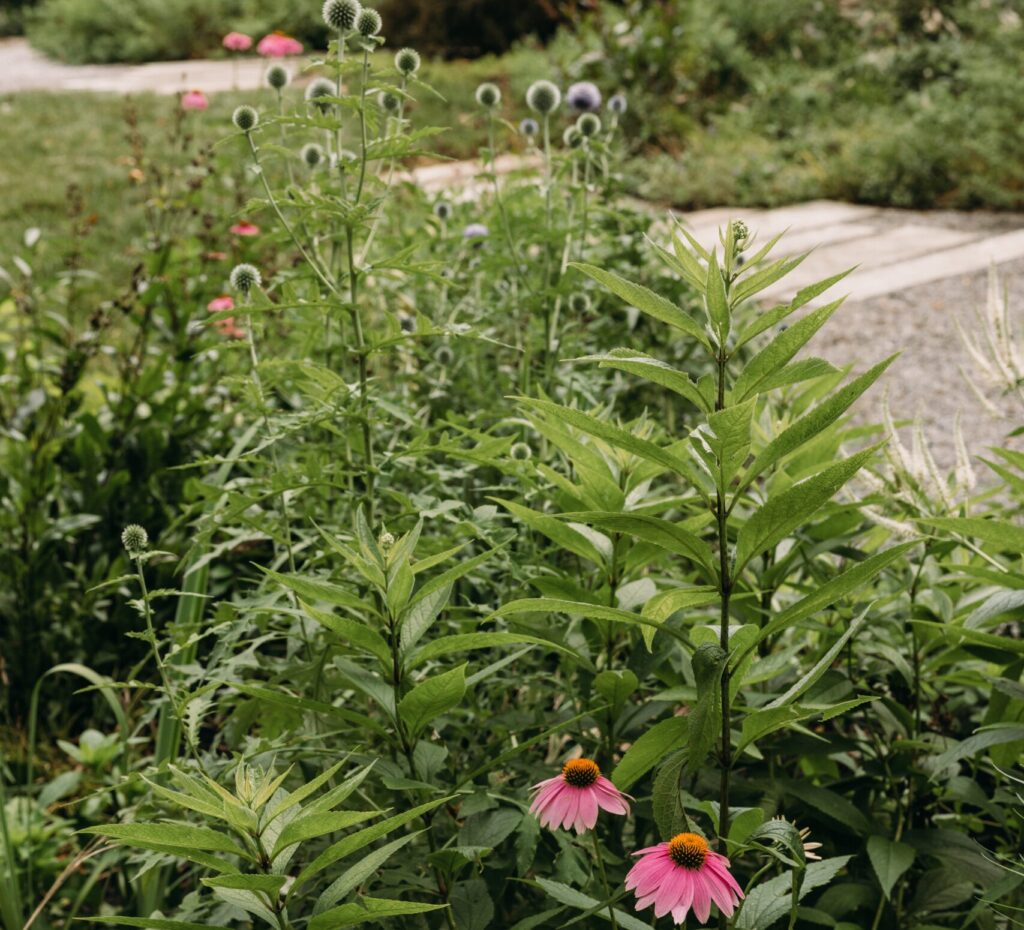
Purple coneflower (Echinacea purpurea) is a cornerstone of an elegant summer palette. It’s bold, structural, and a full-service resource for pollinators, offering pollen, nectar, and seed in a single plant. We often pair it with lanceleaf coreopsis (Coreopsis lanceolata), which blooms earlier in the season and bridges the gap between spring and high summer, and bee balm (Monarda fistulosa), whose lavender blooms are among the most effective hummingbird and bumblebee attractors in the region.
For the monarch migration window, the milkweed trio is a favorite. It’s made up of butterfly weed (Asclepias tuberosa) for dry, sunny slopes and borders; swamp milkweed (Asclepias incarnata) along rain gardens or low-lying areas; and whorled milkweed (Asclepias verticillata), which tucks between taller perennials with an airy, fine-textured presence. One caution, however, is that tropical milkweed (commonly sold in garden centers) is non-native and can disrupt monarch migration patterns and increase parasite pressure. If you’re experimenting with your garden, it’s best to leave this one off the palette.
As we look toward late summer, the season transitions beautifully with Joe-Pye weed (Eutrochium fistulosum), a towering, vanilla-scented magnet for monarchs and swallowtails. And blue mistflower (Conoclinium coelestinum), which carries a haze of soft blue into the edges of a planting well into fall. Black-eyed Susans (Rudbeckia hirta) and showy goldenrod (Solidago speciosa) round out the fall nectar bar. And here’s something you may not realize: contrary to popular belief, goldenrod does not cause allergies. That reputation belongs to ragweed, which blooms at the same time. Goldenrod is insect-pollinated, not wind-pollinated, and is one of the most ecologically productive native plants in the eastern United States.
When we’re incorporating shrubs and trees, Carolina allspice (Calycanthus floridus) brings deep burgundy, spicy-fragrant blooms that attract bees and butterflies throughout its long season, while the flowering dogwood (Cornus florida) and Eastern redbud (Cercis canadensis) provide canopy-level interest and critical early-season pollinator resources. Buttonbush (Cephalanthus occidentalis) is a spectacular mid-summer shrub for wetter areas of an estate, producing globe-shaped white flowers that are visually extraordinary and unlike anything else in the landscape.
Design Intelligence: What Separates a Landscape from a Garden
The design principles that govern a truly high-performing pollinator-friendly landscaping project include plant selection, bloom sequencing, layered structure, water features, and the spatial relationship between plantings. All these elements, when professionally orchestrated, are what elevate a collection of plants into a cohesive, living landscape.
Planting in significant drifts instead of isolated specimens is essential. Pollinators are more efficient foragers when they can move through concentrated patches of a single species, and larger groupings read with far more design authority in an estate setting.
Strategic layering from ground cover to shrub to canopy creates the structural depth that refined landscapes demand, while also providing an overwintering habitat that makes a property genuinely functional for wildlife. Leaving some areas of exposed soil and retaining hollow stems through winter may seem counterintuitive in a high-end context, but executed with intention and the right maintenance program, it is entirely consistent with an elegant aesthetic.
Integral to successful landscape design is the management piece of the puzzle. This is where our clients experience the difference a full-service landscape design team makes. Our approach to the ongoing care of every landscape accounts for cut timing, organic inputs, and seasonal adjustments to plantings, preserving the long-term health, resilience, and integrity of the original design.
Your Tennessee Property, Elevated
The clients we work with across Middle Tennessee understand that, in terms of what their estates represent aesthetically and ecologically, intention is key. A pollinator-friendly landscape designed and built by our team of experts is rooted in the fullest expression of beauty and purpose.
If you’re ready to transform your outdoor space into something that is genuinely extraordinary, reach out to Landscape Solutions for a consultation. From plans, palettes, and plantings to hardscape installations and long-term care, our team handles every detail with unequaled precision. Get in touch today.